Introduction

Introduction, index numbers and price indices : Activities

Definition of inflation

1. Inflation is defined as a sustained increase in the general price level. This implies that for inflation to occur, it is sufficient for only the price of oil to increase.

Incorrect. The statement is false.

Inflation is a sustained increase in the general price level. This means that there is an overall increase in the prices of most goods and services and not only in the price of a good such as oil.

Correct. The statement is indeed false.

Inflation is a sustained increase in the general price level. This means that there is an overall increase in the prices of most goods and services nd not only in the price of a good such as oil.

2. Inflation is a sustained increase in the general price level. This implies that for inflation to occur, all prices must increase.

Incorrect. The statement is false.

Inflation is a sustained increase in the general price level. This means that there is an overall increase in the prices of most goods and services. The prices of some goods and services, however, might decrease.

Correct. The statement is indeed false.

Inflation is a sustained increase in the general price level. This means that there is an overall increase in the prices of most goods and services. The prices of some goods and services, however, might decrease.

3. To measure inflation, a yardstick is needed of the general price level and an appropriate period for measuring changes in the yardstick.

Correct. The statement is indeed true.

This is the reason that a price index is needed.

Incorrect. The statement is true.

This is the reason that a price index is needed.

Index numbers

Watch the following video clip about index numbers:


Questions 4 to 10 are based on the following table:

Employment in the non-agricultural sector
Year Number of people Index (one decimal place)
2014 9 775 711
2015 9 757 126
2016 9 803 589
2017 9 785 004
2018 9 840 759

4. Complete the following table by creating an index with the base year as 2016:

Employment in the non-agricultural sector
Year Number of people Index (one decimal place)
2014 9 775 711
2015 9 757 126
2016 9 803 589
2017 9 785 004
2018 9 840 759
Employment in the non-agricultural sector
Year Number of people Index (one decimal place)
2014 9 775 711 99,7
2015 9 757 126 99,5
2016 9 803 589 100,0
2017 9 785 004 99,8
2018 9 840 759 100,4

The calculation for the index value for 2014 is as follows:

$$
\Biggl(
\frac{\text{Number of people employed in 2014}}{\text{Number of people employed in 2016 (base year)}}
\Biggl)
\times 100
$$

$$
\Biggl(
\frac{\text{9 775 711}}{\text{9 803 589)}}
\Biggl)
\times 100
$$

= 99,7

5. The index numbers in the above table are the ratio of the number of people employed in the informal sector at a specified period to its base value during 2018.

Incorrect. The statement is false.

An index number is the ratio of the value of a variable or group of variables at a given time or during a specified period to its value at a base time or during a base period.

In this example the variable is the number of people employed in the non-agricultural sector and the base period is 2016 and not 2018.

Correct. The statement is indeed false.

An index number is the ratio of the value of a variable or group of variables at a given time or during a specified period to its value at a base time or during a base period.

In this example the variable is the number of people employed in the non-agricultural sector and the base period is 2016 and not 2018.

6. The frequency of the above index numbers is yearly.

Correct. The statement is indeed true.

The index numbers are based on yearly figures for employment in the non-agricultural sector.

Incorrect. The statement is false.

The index numbers are based on yearly figures for employment in the non-agricultural sector.

7. The above index is an example of a …

Correct. It is a specific index.

A specific index contains a single variable. In this case the variable is employment in the non-agricultural sector.

A general or composite index is obtained by combining various variables or specific indices in one index.

Incorrect. It is a specific index.

A specific index contains a single variable. In this case the variable is employment in the non-agricultural sector.

A general or composite index is obtained by combining various variables or specific indices in one index.

8. The index value (one decimal place) for 2018 is …

Correct. It is 100,4.

The calculation for the index value for 2018 is as follows:

$$
\Biggl(
\frac{\text{9 840 759}}{\text{7 803 589)}}
\Biggl)
\times 100
$$

= 100,4

Incorrect. It is 100,4.

The calculation for the index value for 2018 is as follows:

$$
\Biggl(
\frac{\text{9 840 759}}{\text{7 803 589)}}
\Biggl)
\times 100
$$

= 100,4

9. The percentage change in the index value from 2016 to 2017 is …

%

Correct. The index value declined by -0,2%.

$$
\Biggl[
\Biggl(
\frac{\text{Index value 2017}}{\text{Index value 2016}}
\Biggl)-1
\Biggl]
\times 100
$$

$$
\Biggl[
\Biggl(
\frac{\text{99,8}}{\text{100}}
\Biggl)-1
]
\times 100
$$

= (0,998 -1) x 100
= -0,002 x 100
= -0,2%

Incorrect. The answer is -0,2%.

10. The percentage change in the index value from 2017 to 2018 is…

%

Correct. The index value increased by 10,6%.

$$
\Biggl[
\Biggl(
\frac{\text{Index value 2018}}{\text{Index value 2017}}
\Biggl)-1
\Biggl]
\times 100
$$

$$
\Biggl[
\Biggl(
\frac{110,4}{99,8}
\Biggl)-1
\Biggl]
\times 100
$$

= (1.106 -1) x 100
= 0,106 x 100
= 10,6%

Incorrect. The index value increased by 10,6%.

$$
\Biggl[
\Biggl(
\frac{\text{Index value 2018}}{\text{Index value 2017}}
\Biggl)-1
\Biggl]
\times 100
$$

$$
\Biggl[
\Biggl(
\frac{110,4}{99,8}
\Biggl)-1
\Biggl]
\times 100
$$

= (1.106 -1) x 100
= 0,106 x 100
= 10,6%

11. If the number of people employed in the manufacturing sector in 2018 was 1 193 311 and the index value for 2017 was 95,3, how many people were employed in the base year?

Correct. In the base year 1 252 163 people were employed.

The calculation is:

$$
\Biggl(
\frac{100}{\text{95,3)}}
\Biggl)
\times \text{1 193 311}
$$

= 1 252 163

Note that the index value for the base year is 100.

Incorrect. In the base year 1 252 163 people were employed.

The calculation is:

$$
\Biggl(
\frac{100}{\text{95,3)}}
\Biggl)
\times \text{1 193 311}
$$

= 1 252 163

Note that the index value for the base year is 100.

12. An index number on its own does not indicate the actual level of a variable. It only indicates the change since the base period.

Correct. The statement is indeed true.

The index number on its own does not tell you anything about the actual level of the variable. You need more information than just the index value to reach a conclusion about the actual level.

Incorrect. The statement is true.

The index number on its own does not tell you anything about the actual level of the variable. You need more information than just the index value to reach a conclusion about the actual level.

13. The year 2020 would …

Incorrect.

Being recent is an important criterion for a base period, but the period also needs to be a stable or normal period. Due to the Covid-19 pandemic, 2020 was not a stable or normal period.

Incorrect.

It was not a census year.

Correct.

An important criterion for a base year is that it should be a stable or normal period. Due to the Covid-19 pandemic, 2020 was not a stable or normal period.

Price index

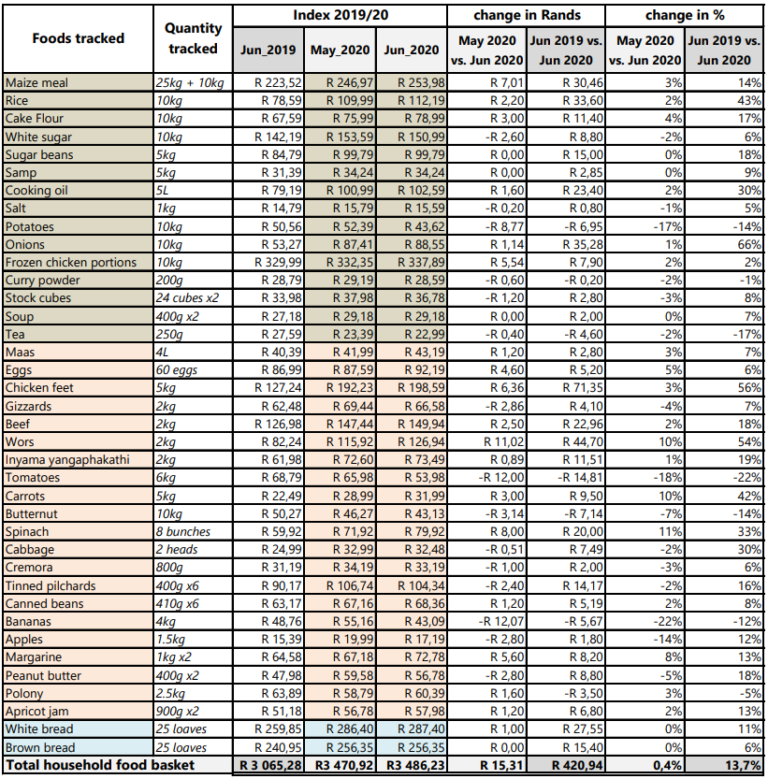
Questions 14 to 22 are based on the calculations done by The Pietermaritzburg Economic Justice and Dignity Group on the average price for a household food basket. Use the following table that they have compiled to answer the questions:

Household Food Index

14. Using June 2019 as the base period, convert the cost of a total household food basket into an index.

Total household food basket Index value
June 2019
May 2020
June 2020
Total household food basket Index value (one decimal point)
June 2019 100
May 2020 113,2
June 2020 113,7

The base date value is June 2019 and the index value is therefore 100.

The index value for May 2020 is

$$
\Biggl(
\frac{\text{Cost of household basket for May 2020}}{\text{Cost of household basket for June 2019)}}
\Biggl)
\times 100
$$

$$
\Biggl(
\frac{\text{3 470,92}}{\text{3 065,28)}}
\Biggl)
\times 100
$$

= 113,7

The index value for June 2020 is

$$
\Biggl(
\frac{\text{Cost of household basket for June}}{\text{Cost of household basket for June 2019)}}
\Biggl)
\times 100
$$

$$
\Biggl(
\frac{\text{3 470,92}}{\text{3 065,28)}}
\Biggl)
\times 100
$$

= 113,7

15. A price index number is the ratio of the cost of a basket of goods and services in the current period to the cost of the basket in the base period, usually multiplied by 100 (so that the value in the base period = 100).

Correct. The statement is indeed true.

See question 14.

Incorrect. The statement is true.

See question 14.

16. The above index is an example of a …

Incorrect. It is a general or composite index.

A general or composite index is obtained by combining various variables or specific indices in one index.

A specific index contains a single variable, for instance employment in the non-agricultural sector.

Correct. It is a general or composite index.

A general or composite index is obtained by combining various variables or specific indices in one index.

A specific index contains a single variable, for instance employment in the non-agricultural sector.

17. The increase in the index value for the period May 2019 to May 2020 is far greater than the change in the index value for the period May 2020 to June 2020. This is due to the difference in the time period.

Correct. The statement is indeed true.

According to the index values, the cost of an average basket of food increased for the period June 2019 to June 2020 by 13,7%, and for May 2020 to June 2020 it increased by 0,4%. The difference is due to the difference in the time period.

Incorrect. The statement is true.

According to the index values, the cost of an average basket of food increased for the period June 2019 to June 2020 by 13,7%, and for May 2020 to June 2020 it increased by 0,4%. The difference is due to the difference in the time period.

18. In the construction of a price index, equal weights are usually assigned to all the items.

Incorrect. The statement is false.

In constructing a price index different weights are usually allocated to different items.

Correct. The statement is indeed false.

In constructing a price index different weights are usually allocated to different items.

19. If you use the data for June 2019 to calculate the weight in terms of the amount spent on the different items, then the weight out of 100 for the spending on brown bread is ...

Correct. The weight is 7,9.

According to the data for June 2019, households spent R240,95 on brown bread. The total spending for June 2019 was R3 065,28.

The weight of brown bread is therefore

$$
\Biggl(
\frac{\text{R240,95}}{\text{R3 065,28)}}
\Biggl)
\times 100
$$

= 7,9

Incorrect. It is 7,9.

According to the data for June 2019, households spent R240,95 on brown bread. The total spending for June 2019 was R3 065,28.

The weight of brown bread is therefore

$$
\Biggl(
\frac{\text{R240,95}}{\text{R3 065,28)}}
\Biggl)
\times 100
$$

= 7,9

20. Indicate whether you agree or disagree with the following explanation:

While the price of onions increased by 66% for the period June 2019 to June 2020, the average price of a food basket only increased by 13,7%. This is partly due to the fact that spending on onions has a relatively low weight in the basket of goods. Another reason is that the price of some items has decreased, and the increase in other items was far less than 66%.

Correct.

You should agree since onions have a relatively low weight (2,5 in June 2020) and an increase in the price will consequently have a smaller impact on the average price of the goods basket. From the table it is also clear that prices of goods such as potatoes and bananas decreased.

[Insert video clip]

Incorrect.

You should agree since onions have a relatively low weight (2,5 in June 2020) and an increase in the price will consequently have a smaller impact on the average price of the goods basket. From the table it is also clear that prices of goods such as potatoes and bananas decreased.

[Insert video clip]

21. It can be argued that the food basket price index has an upward bias since the volume of goods purchased stayed the same regardless of the price.

Correct. The statement is indeed true.

For instance, while the price of onions increased by 66%, it is assumed that the same quantity of onions (10 kg) will be bought. According to the law of demand, as the price of something rises, less of it is demanded, which is not taken into account in this instance.

Incorrect. The statement is true.

For instance, while the price of onions increased by 66%, it is assumed that the same quantity of onions (10 kg) will be bought. According to the law of demand, as the price of something rises, less of it is demanded, which is not taken into account in this instance.

22. This price index is an example of a Laspeyres price index.

Correct. The statement is indeed true.

The Laspeyres price index is an index formula used in price statistics for measuring the price development of the basket of goods and services consumed in the base period using fixed period base weights. A Paasche index uses current period weights.

Incorrect. The statement is true.

The Laspeyres price index is an index formula used in price statistics for measuring the price development of the basket of goods and services consumed in the base period using fixed period base weights. A Paasche index uses current period weights.

23. In this news article in the City Press the writer argues that people are paying up to 30% more for food than they were before the Covid-19 coronavirus-enforced lockdown began on 26 March.

Source: https://www.news24.com/citypress/news/the-poor-are-hit-hard-as-cost-of-food-increases-by-30-20200608

In your view, is this increase of 30% the result of …

Incorrect.

This is an example of a misleading sentence. The main reason why households spend more on food is that they have increased the volume of food they buy.

[Insert video clip]

Correct.

This is an example of a misleading sentence. The main reason why households spend more on food is that they have increased the volume of food they buy and not because of an increase in the price of food. The price of food probably increased by less than 1% from March 2020 to April 2020.

Technical and fundamental shifting

24. If you wish to compare two price indices where the base year differs, it is possible through technical shifting to change the base year.

Correct. The statement is indeed true.

Through technical shifting the base year of a price index can be changed, provided that the same weights have been used to calculate all the index numbers of the price index.

Incorrect. The statement is true.

Through technical shifting the base year of a price index can be changed, provided that the same weights have been used to calculate all the index numbers of the price index.

Changing the base year

25. Complete the following table by changing the base year from 2015 to 2020:

Year Base year 2015 Base year 2020
2108 112,4
2019 114,6
2020 118,2
2021 121,4
2022 124,8
Year Base year 2015 Base year 2020
2108 112,4 95,1
2019 114,6 97,0
2020 118,2 100,0
2021 121,4 102,7
2022 124,8 105,6

The 2020 index value is calculated by dividing each original index number by the 2020 index number and multiplying it by 100.
The calculation for 2018 is

$$
\Biggl(
\frac{\text{112,4}}{\text{118,2)}}
\Biggl)
\times 100
$$

= 95,1

26. A technical shift of the base period is equivalent to a fundamental shift of the base period.

Incorrect. The statement is false.

A fundamental shift is when a new index is constructed with a new basket or new weights and a new base year.

Correct. The statement is indeed false.

A fundamental shift is when a new index is constructed with a new basket or new weights and a new base year.

27. The treatment of quality changes and the introduction of new products are two of the problems associated with a current price index.

Correct. The statement is indeed true.

Quality and new products are not always reflected in current price indices.

Incorrect. The statement is true.

Quality and new products are not always reflected in current price indices.